Kamares Aqueduct in Larnaca. The Largest Aqueduct in Cyprus
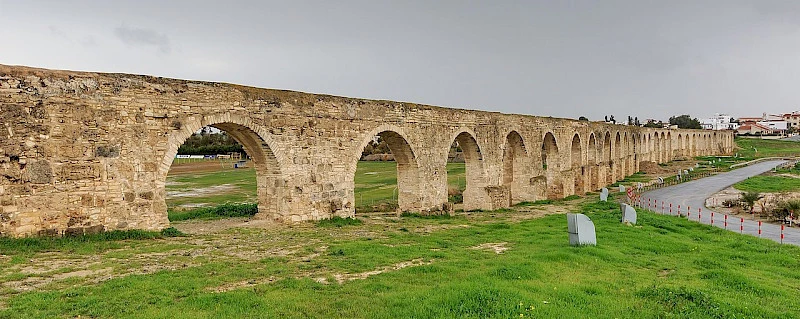
The Kamares Aqueduct is one of the most famous historical landmarks in Larnaca. The structure was built in 1746 on the initiative of Bekir Pasha to supply water to the city from a spring about 10 km from Larnaca. The aqueduct was in use until 1939, and today it is a popular place for walks and photos. Admission is free, and access is open 24/7.
- What the Kamares Aqueduct Is
- History of the Aqueduct
- How to Visit the Aqueduct
- How to Get There
- What to See Nearby
- Frequently Asked Questions
What the Kamares Aqueduct Is
Kamares is an old water supply aqueduct near Larnaca. The name comes from the Greek word “kamares,” meaning “arches.”
The structure was built during the Ottoman period, but it visually resembles Roman aqueducts. Its second common name is the Bekir Pasha Aqueduct.
The aqueduct was funded by Larnaca governor Bekir Pasha and was used to supply the city with water for almost 200 years.
History of the Aqueduct
In the 18th century, Larnaca suffered from a shortage of fresh water. To solve the problem, a system of channels and arches was built, through which water was brought from a distant source to the city.
Historical descriptions indicate that the entire complex included about 75 arches. The most well-known part of the aqueduct that has survived to this day is near the road to Limassol.
In 1939, the system stopped being used for its intended purpose after the modernization of the city’s infrastructure.
| Fact | Details |
|---|---|
| Location | Larnaca, Kamares area |
| Year built | 1746 |
| Project initiator | Bekir Pasha |
| Purpose | Supplying water to Larnaca |
| System length | About 10 km |
| Operational period | Until 1939 |
| Visit cost | Free |
How to Visit the Aqueduct
The aqueduct is located in an open area near the road. Entry is free, and no tickets are required.
The best time to visit is in the morning, at sunset, or in the evening. After dark, the arches are illuminated.
There are walking paths and rest areas nearby. Many tourists combine a visit to the aqueduct with a walk to Larnaca Salt Lake.
How to Get There
The aqueduct is located at the exit from Larnaca toward Limassol, near B5 road.
By Car
From the center of Larnaca, the drive usually takes about 10 minutes. There are places nearby for a short stop.
For trips around the Republic of Cyprus, many tourists rent a car. You can compare rental options via Localrent.
On Foot
You can walk to the aqueduct from Larnaca Salt Lake along walking routes.
What to See Nearby
Not far from the aqueduct is Larnaca Salt Lake — one of the main places to observe flamingos in the Republic of Cyprus.
Also nearby are:
- Saint Lazarus Church;
- Mackenzie Beach;
- Finikoudes Promenade;
- the center of Larnaca.
If you are planning walks around the city or excursions around the island, you can check options on Tripster or Sputnik8.
For a trip to Larnaca, travel insurance may also come in handy, especially if you plan to rent a car or enjoy active recreation.
Frequently Asked Questions
Is the Kamares Aqueduct the largest aqueduct in Cyprus?
It is often called the most famous and one of the largest historical aqueducts in the Republic of Cyprus.
How much does the visit cost?
Admission is free.
Are there opening hours?
No. The aqueduct is located in an open area and is accessible 24/7.
How much time do you need for a visit?
Usually 15–30 minutes is enough. If you combine the visit with a walk by the salt lake, it is worth allowing more time.
How do I find the aqueduct in a navigator?
Use the names Kamares Aqueduct or Bekir Pasha Aqueduct.
Author

I am a person who is not afraid to change life when my heart tells me that something greater lies ahead. I am originally from Belarus. I have journeyed from pedagogical and economic education to the financial sector and many years of work in logistics — a world where everything moves, changes,…
You may also be interested in:
- Dragon’s Cave in Pomos: the dragon’s cave in northwestern Cyprus
- Episkopi in the Paphos region: a sheer cliff, the Ezousa Valley, and hidden places
- Troodos Ophiolite: Cyprus’s Main Geological Landmark
- Cyprus Perfumery Theme Park: the history of ancient perfumery in the Republic of Cyprus
- Polis and Latchi: the sea, villages, Akamas, and wineries of the northwest of the Republic of Cyprus
Comments